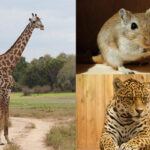
Animal Names Starting With P in Spanish
Explore our complete list of animal names in Spanish that start with P. From the friendly perro (dog) to the colorful pavo real (peacock), this list includes images and example sentences to help you master this essential vocabulary.
The letter P is the richest in Spanish animal vocabulary — no other letter comes close. This guide covers 30 animals that start with P in Spanish, from el pájaro (bird) to el puma (puma). The list spans birds, mammals, fish, reptiles, and insects, including some of the most common words in everyday Spanish: el perro (dog), el pato (duck), el pez (fish), and el pollo (chicken).
Because P is so productive, this page is longer than most in our animal vocabulary series. It’s built to be skimmed — the Quick List below lets you jump straight to any animal. A few entries are worth highlighting for learners: pájaro is the generic word for a small bird, but ave is the general word for any bird; pavo means turkey but pavo real (literally “royal turkey”) means peacock; and pollo refers to a young chicken, not an adult one, which is gallina (hen) or gallo (rooster). These distinctions trip up English speakers because English uses “chicken” for all of them.
📋 Quick List: P Animals in Spanish
- Pájaro — Bird (el)
- Pájaro carpintero — Woodpecker (el)
- Paloma — Pigeon/Dove (la)
- Panda — Panda (el)
- Panda rojo — Red panda (el)
- Pangolín — Pangolin (el)
- Pantera — Panther (la)
- Pato — Duck (el)
- Pavo — Turkey (el)
- Pavo real — Peacock (el)
- Pelícano — Pelican (el)
- Perdiz — Partridge (la)
- Perezoso — Sloth (el)
- Periquito — Parakeet (el)
- Perro — Dog (el)
- Petirrojo — Robin (el)
- Pez — Fish (el)
- Pez espada — Swordfish (el)
- Pingüino — Penguin (el)
- Pinzón — Finch (el)
- Piojo — Louse (el)
- Piraña — Piranha (la)
- Pitón — Python (la)
- Polilla — Moth (la)
- Pollo — Chicken (el)
- Potro — Foal (el)
- Puercoespín — Porcupine (el)
- Pulga — Flea (la)
- Pulpo — Octopus (el)
- Puma — Puma (el)
Pájaro – Bird in Spanish (el)
Cada mañana, un pájaro canta fuera de mi ventana. (Every morning, a bird sings outside my window.)

Note: Pájaro is masculine and generally refers to a small bird. Spanish distinguishes pájaro (small bird) from ave (any bird, including large ones like eagles). The word appears in one of the most common Spanish sayings: más vale pájaro en mano que ciento volando — “a bird in the hand is worth a hundred flying.”
Pájaro carpintero – Woodpecker in Spanish (el)

Escuchamos el sonido del pájaro carpintero en el bosque. (We heard the sound of the woodpecker in the forest.)
Note: Pájaro carpintero is masculine and literally means “carpenter bird” — carpintero comes from carpintero (carpenter), referring to the bird’s habit of drilling into wood. In some regions, carpintero alone is used. The compound follows Spanish’s pattern of naming animals by what they do, like pájaro mosca (hummingbird, literally “fly bird”).
Paloma – Pigeon/Dove in Spanish (la)
Una paloma blanca es a menudo un símbolo de paz. (A white dove is often a symbol of peace.)

Note: Paloma is feminine. Spanish uses the same word for both pigeon and dove, unlike English. A male pigeon is palomo, and a young one is pichón. The white dove as a peace symbol is universal, and paloma de la paz is the standard Spanish phrase. Pablo Picasso’s famous peace dove is la paloma de Picasso in Spanish.
Panda – Panda in Spanish (el)
El panda gigante pasa la mayor parte del día comiendo bambú. (The giant panda spends most of its day eating bamboo.)

Note: Panda is masculine. The word entered Spanish through French, and its ultimate origin is uncertain — possibly from Nepali ponya (bamboo eater). The full name in Spanish is panda gigante (giant panda) to distinguish it from panda rojo (red panda). Despite being a bear, the panda’s diet is almost entirely bamboo.
Panda rojo – Red Panda in Spanish (el)
El panda rojo se balanceaba hábilmente entre las ramas. (The red panda was skillfully balancing between the branches.)

Note: Panda rojo is masculine. Despite the shared name, the red panda is not closely related to the giant panda — it belongs to its own family, Ailuridae. The Spanish name mirrors the English one exactly. Red pandas are native to the eastern Himalayas and southwestern China and are endangered.
Pangolín – Pangolin in Spanish (el)
El pangolín se enrolló como una bola para protegerse. (The pangolin rolled up into a ball to protect itself.)
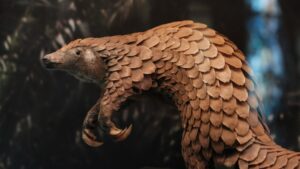
Note: Pangolín is masculine and carries an accent on the final syllable: pan-go-LÍN. The word comes from Malay pengguling (one who rolls up), referring to the animal’s defensive behavior. Pangolins are the only mammals covered in scales and are among the most trafficked animals in the world. In Spanish, the plural is pangolines.
Pantera – Panther in Spanish (la)
Una pantera negra se movía sigilosamente en la oscuridad. (A black panther moved stealthily in the darkness.)
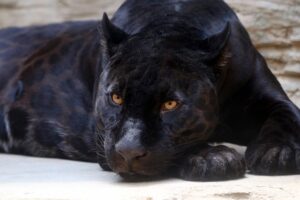
Note: Pantera is feminine. It comes from Latin panthera, ultimately from Greek, and is the same root that gives English panther. A “black panther” is not a separate species — it’s a melanistic leopard or jaguar. In Spanish, pantera negra is the standard term. The word is also used figuratively for a fierce or aggressive person.
Pato – Duck in Spanish (el)
Un pato y sus patitos nadaban en el estanque del parque. (A duck and her ducklings were swimming in the park pond.)

Note: Pato is masculine. A female duck is pata, and a duckling is patito — the diminutive form, which also appears in the children’s song Los patitos and the idiom pagó el pato (he paid the price, literally “he paid the duck”). Ducks are common in Spanish parks and appear frequently in children’s stories.
Pavo – Turkey in Spanish (el)
En la granja, el pavo hacía un ruido muy característico. (On the farm, the turkey made a very distinctive noise.)
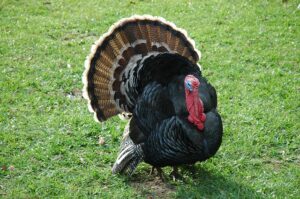
Note: Pavo is masculine. The female is pava, and a young turkey is pavipollo. In Spain, pavo is also used colloquially to mean “a euro” — tengo veinte pavos means “I have twenty euros.” The turkey is native to North America and was brought to Europe by Spanish explorers in the 16th century.
Pavo real – Peacock in Spanish (el)
El pavo real abrió su cola para mostrar sus hermosas plumas. (The peacock opened its tail to display its beautiful feathers.)
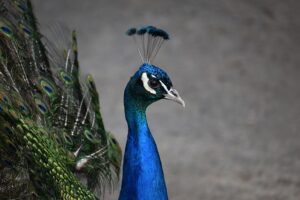
Note: Pavo real is masculine and literally means “royal turkey” — real means “royal.” This is one of the most memorable compound animal names in Spanish, and it shows how Spanish often describes animals by comparison to a more familiar one. The female peacock is pava real, and the tail feathers are plumas.
Pelícano – Pelican in Spanish (el)
El pelícano atrapó un pez con su gran pico. (The pelican caught a fish with its large beak.)
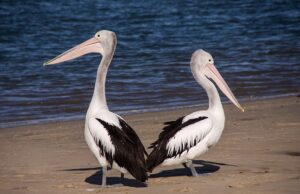
Note: Pelícano is masculine and carries an accent on the second syllable: pe-LÍ-cano. It comes from Latin pelicanus, ultimately from Greek pelekan, and is the same root that gives English pelican. The pelican’s throat pouch can hold up to 13 liters of water — more than three times the capacity of its stomach.
Perdiz – Partridge in Spanish (la)
Los cazadores salieron temprano para buscar perdiz. (The hunters went out early to look for partridge.)
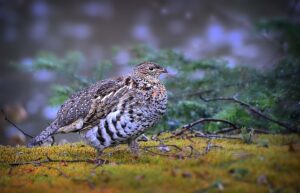
Note: Perdiz is feminine and has an irregular plural: perdices. It comes from Latin perdix, ultimately from Greek. The partridge is a common game bird in Spain, and perdiz en escabeche (pickled partridge) is a traditional dish. The word appears in the Spanish expression más vale pájaro en mano… — wait, that uses pájaro, not perdiz. A more relevant phrase is estar como una perdiz (to be very healthy, literally “to be like a partridge”).
Perezoso – Sloth in Spanish (el)
El perezoso se mueve muy lentamente por los árboles de la jungla. (The sloth moves very slowly through the jungle trees.)
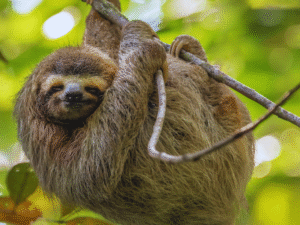
Note: Perezoso is masculine and literally means “lazy” — the same word is used as an adjective in Spanish (un estudiante perezoso = a lazy student). The animal was named for its slow movements. Sloths are native to Central and South America and are known for sleeping up to 20 hours a day. The Spanish name is a direct translation of the Latin pigritia (laziness).
Periquito – Parakeet in Spanish (el)
El periquito verde canta alegremente en su jaula. (The green parakeet sings happily in its cage.)
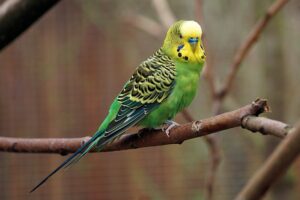
Note: Periquito is masculine and is the standard Spanish word for a parakeet. In some regions, especially Mexico and the Caribbean, perico is the more common term — and it’s also used colloquially to mean “cocaine” in some countries, so context matters. Periquito is the safer word for the bird. The word is a diminutive of perico, which itself may come from a proper name.
Perro – Dog in Spanish (el)
Mi perro ladra cada vez que alguien llama a la puerta. (My dog barks every time someone rings the doorbell.)

Note: Perro is masculine. The female is perra, and a puppy is cachorro. The origin of the word is uncertain — it may come from a pre-Roman Iberian language, since Latin used canis (which gives Spanish canino and English canine). Perro is one of the most common Spanish words and appears in many idioms: perro viejo (old dog, meaning an experienced person), a otro perro con ese hueso (tell that to someone else).
Petirrojo – Robin in Spanish (el)
Un petirrojo construyó su nido en nuestro jardín. (A robin built its nest in our garden.)
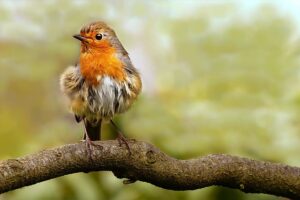
Note: Petirrojo is masculine and is a compound of peti- (from pito, a small bird) + rojo (red), literally “red small bird.” The name refers to the robin’s distinctive orange-red breast. Robins are common in gardens across Europe and are often associated with winter and Christmas in British and Spanish culture — the petirrojo appears on many holiday cards.
Pez – Fish in Spanish (el)
Los niños observaban los coloridos peces tropicales en el acuario. (The children watched the colorful tropical fish in the aquarium.)

Note: Pez is masculine and has an irregular plural: peces. This is one of the most useful distinctions in Spanish: pez refers to a live fish in the water, while pescado refers to fish as food. Voy a pescar un pez (I’m going to catch a fish), but compré pescado (I bought fish [to eat]). The word comes from Latin piscis, the same root that gives English piscine.
Pez espada – Swordfish in Spanish (el)
Vimos un enorme pez espada en el acuario. (We saw a huge swordfish at the aquarium.)

Note: Pez espada is masculine and literally means “sword fish” — espada means “sword.” This is a compound noun following the pattern of pájaro carpintero and pavo real. The swordfish is known for its long, flat bill, which it uses to stun prey. In Spanish, the plural is peces espada — the first element is pluralized, not the second.
Pingüino – Penguin in Spanish (el)
El pingüino es un ave que no puede volar, pero nada muy bien. (The penguin is a bird that cannot fly, but it swims very well.)
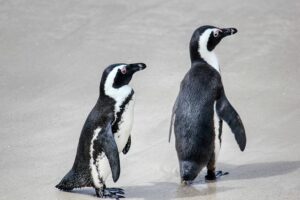
Note: Pingüino is masculine and carries a diaeresis on the ü: pin-GÜI-no. The diaeresis means the *u* is pronounced — without it, gui would sound like “gee.” The word comes from French pingouin, ultimately from Dutch. Penguins are found almost entirely in the Southern Hemisphere, from Antarctica to the Galápagos Islands.
Pinzón – Finch in Spanish (el)
Un pequeño pinzón come semillas en el balcón. (A small finch eats seeds on the balcony.)
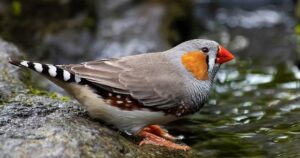
Note: Pinzón is masculine and carries an accent on the final syllable: pin-ZÓN. The plural is pinzones. The word comes from Latin pincio, a type of finch. Finches are small seed-eating birds found worldwide, and Darwin’s finches — pinzones de Darwin — are among the most famous examples of evolution by natural selection.
Piojo – Louse in Spanish (el)
En la escuela a veces hay alerta por piojos. (At school, there is sometimes a lice alert.)

Note: Piojo is masculine. The plural piojos means lice. The word comes from Latin peduculus, a diminutive of pedis (louse). Head lice are a common childhood problem in schools, and the phrase alerta por piojos (lice alert) is familiar to Spanish-speaking parents. The word is also used figuratively: piojo resucitado (literally “resurrected louse”) means a social climber.
Piraña – Piranha in Spanish (la)
Las pirañas son peces de agua dulce muy voraces. (Piranhas are very voracious freshwater fish.)

Note: Piraña is feminine and carries an accent on the final syllable: pi-ra-ÑA. The word comes from Tupi, an indigenous language of Brazil, through Portuguese. Piranhas are freshwater fish native to South America, known for their sharp teeth and aggressive feeding behavior — though most species are actually omnivorous and not as dangerous as popular culture suggests. The Spanish word is feminine because it ends in -a.
Pitón – Python in Spanish (la)
Una pitón puede estrangular a su presa. (A python can constrict its prey.)
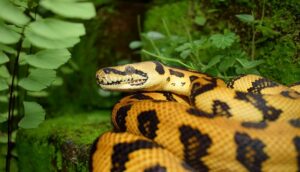
Note: Pitón is feminine and carries an accent on the final syllable: pi-TÓN. The word comes from Latin python, ultimately from Greek Pythōn, the mythical serpent slain by Apollo. Pythons are non-venomous snakes that kill by constriction. In Spanish, the feminine gender is unusual for a word ending in -ón, but it follows the pattern of other snake names like la serpiente and la víbora.
Polilla – Moth in Spanish (la)
Una polilla se acercó volando a la luz de la lámpara. (A moth flew towards the lamp light.)
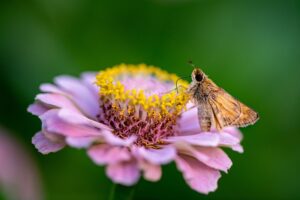
Note: Polilla is feminine. The word comes from Latin papilio (butterfly), which also gives Spanish pabellón (pavilion, originally “butterfly-shaped tent”). Moths and butterflies are both lepidópteros in Spanish. The distinction between mariposa (butterfly) and polilla (moth) is not always clear in everyday use — some small dull-colored butterflies are called polillas.
Pollo – Chicken in Spanish (el)
El pollo corre por el patio de la granja. (The chicken runs around the farmyard.)
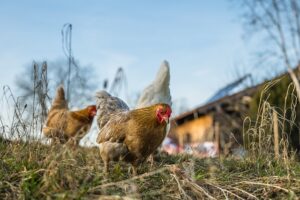
Note: Pollo is masculine and refers to a young chicken or chicken meat. The adult female is gallina (hen), and the adult male is gallo (rooster). This is one of the most common vocabulary mistakes for English speakers: “chicken” in English covers all three stages, but Spanish distinguishes pollo, gallina, and gallo. Pollo is also the standard word for chicken as food.
Potro – Foal in Spanish (el)
El potro seguía de cerca a su madre en el campo. (The colt followed its mother closely in the field.)
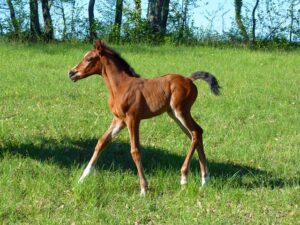
Note: Potro is masculine and refers to a young horse, usually a colt. The female is potra, and the plural is potros. The word comes from Latin pullus (young animal), the same root that gives pollo (chicken). In Spanish, potro is also used for a gymnastic vaulting horse and for a torture device — context makes the meaning clear.
Puercoespín – Porcupine in Spanish (el)
Ten mucho cuidado, el puercoespín tiene púas muy afiladas. (Be very careful, the porcupine has very sharp quills.)
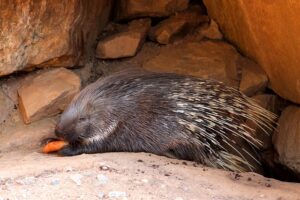
Note: Puercoespín is masculine and carries an accent on the final syllable: puer-co-es-PÍN. The word is a compound of puerco (pig) + espín (spine/thorn), literally “spiny pig.” This is a direct calque of the English porcupine and the French porc-épic. The quills are púas, and porcupines can have up to 30,000 of them.
Pulga – Flea in Spanish (la)
Mi perro se rasca mucho porque tiene pulgas. (My dog scratches a lot because he has fleas.)

Note: Pulga is feminine. The word comes from Latin pulex, the same root that gives English flea. Fleas are small wingless insects that feed on the blood of mammals and birds. In Spanish, pulga appears in several idioms: tener malas pulgas (to have a bad temper, literally “to have bad fleas”), and hacer de una pulga un camello (to make a mountain out of a molehill, literally “to make a camel out of a flea”).
Pulpo – Octopus in Spanish (el)
El pulpo puede cambiar de color para camuflarse con su entorno. (The octopus can change color to camouflage with its surroundings.)
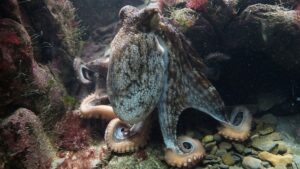
Note: Pulpo is masculine. The word comes from Latin polypus, ultimately from Greek polypous (many-footed), the same root that gives English polyp. Octopuses are highly intelligent cephalopods with three hearts and blue blood. In Spain, pulpo a la gallega (Galician-style octopus) is a famous dish. The word is also used figuratively: ponerse como un pulpo (to get very angry).
Puma – Puma in Spanish (el)
El puma es un gran felino que vive en las montañas de América. (The puma is a large feline that lives in the mountains of the Americas.)

Note: Puma is masculine. The word comes from Quechua, the language of the Inca Empire, and is one of the most widely used indigenous loanwords in Spanish. The puma is known by many names in English — cougar, mountain lion, panther — but Spanish uses puma consistently across most regions. In Argentina and Chile, it’s also called león americano (American lion).
🦜 P Animals in Spanish: Frequently Asked Questions
A: P is the richest letter in Spanish animal vocabulary. Common examples include perro (dog), pato (duck), pájaro (bird), paloma (pigeon/dove), pez (fish), pollo (chicken), pulpo (octopus), puma (puma), and pingüino (penguin). See the full list of 30 above.
A: Mostly masculine, with several feminine exceptions. Masculine examples: el perro, el pato, el pájaro, el pez, el pulpo, el puma. Feminine examples: la paloma, la pantera, la perdiz, la piraña, la pitón, la polilla, la pulga. The feminine ones often end in -a or follow the pattern of other animal names.
A: Perro (masculine, el perro). Example: Mi perro ladra cada vez que alguien llama a la puerta. (My dog barks every time someone rings the doorbell.) The female is perra, and a puppy is cachorro.
A: Pájaro generally refers to a small bird, while ave refers to any bird, including large ones like eagles and ostriches. In everyday Spanish, most people use pájaro for small birds and ave for the general category. The distinction is similar to English “bird” versus “fowl,” though not exactly.
A: This page covers 30 animals that start with P in Spanish, from el pájaro (bird) to el puma (puma). P is the richest letter in the Spanish animal vocabulary, so this list is the longest on the site.